Thursday, October 10, 2013

Morse Farm Maple Sugarworks

The leaves were just beginning to turn, but this flaming red tree gave us a taste of  why people flock to New England to see the fall foliage.


Being from the Pacific Northwest, the opportunity to stay at a maple sugar farm was too good to pass up. Morse Farm Maple Sugarworks, near Montpelier, Vermont, is part of Harvest Hosts, and so we were able to park there overnight.
We were treated to a beautiful sunset over the rolling farmland. 
I was very excited to explore the farm the next morning. We ran into Burr Morse, one of the brothers who run the farm that's been in their family for generations. He was happy to talk with us and answer our questions about how they make maple syrup.  The Burr family helped settle this part of Vermont and learned to tap maple trees from the Native peoples who lived there. At that time hot rocks were used to evaporate water from the sap until only the sugar remained. Ben Franklin highly encouraged the production of maple sugar in the Northeast in the hopes of freeing the United States from dependency on foreign sugar. After Independence, and with improved transportation, more sugar cane was produced for the country in the South. 
A tour group arrived and we were invited to sit in on Burr's presentation in the sugarhouse. Syrup production takes place for only a short run in the spring, so during the rest of the year they stay busy with maintenance and tours. It was very interesting to learn about how much work goes into getting sugar or syrup from sap. It takes 40 gallons of sap to make one gallon of syrup! I will never again complain about the cost of maple syrup now that I've seen how much work goes into it.
There were all kinds of whimsical woodcarvings scattered here and there around the farm.
Modern maple farms no longer hang buckets to collect sap, but instead drill and insert a tube which is under vacuum pressure. The tubes run into a central tank where the sap is collected and stored until it can be boiled down. At Morse Farm, they only drill one hole per tree per season, and each tree will give about ten gallons of sap. Burr says the trees are all wild; he knows of no one that plants maple trees for sugar production, as they take 40 years to give enough sap. So it takes four trees to produce one gallon of pure maple syrup!
After touring the farm we enjoyed browsing the gift shop and sampling the four different grades of maple syrup and my favorite, maple cream.
  
Did you notice Maple Creemees on the sign? That's Vermontese for Maple soft serve ice cream! The cashier in the gift shop joked about how "flatlanders" come up to Vermont and have to ask what a Maple Creemee is! 
We had a great time at Morse Farm Sugarworks. 

Sunday, October 06, 2013

Ben & Jerry's Ice Cream

For a long time, Vermont has held some sort of mythical allure for me,  and in my late teens, I'm afraid that had more than a little to do with my then favorite ice cream, Ben & Jerry's. There happened to be a Harvest Hosts maple farm not too far away, so we took the opportunity to tour the Ben & Jerry's factory near Montpelier. 

The tour began with a fun and informational video about the humble origins of two friends who split the cost of a $5 ice cream making correspondence course. The rest is history, or course! From the Moovie Theatre, we proceeded to an observation area where we could see down onto the factory floor where ice cream was being made. We weren't allowed to take any pictures of this part, you know, just in case we were spies for Haagen Dazs. From there we entered the tasting room, with generous samples for all. 
The flavor of the day was Triple Caramel Chunk, which was delicious. No surprise there!
This year's new flavors, thought up by a team of experts who travel all over the world eating and gleaning inspiration from food trends. Sounds like a yummy job to me!
Euphoric Stuff.
Peregrine and Pearl's!
The famous Cowmobile.


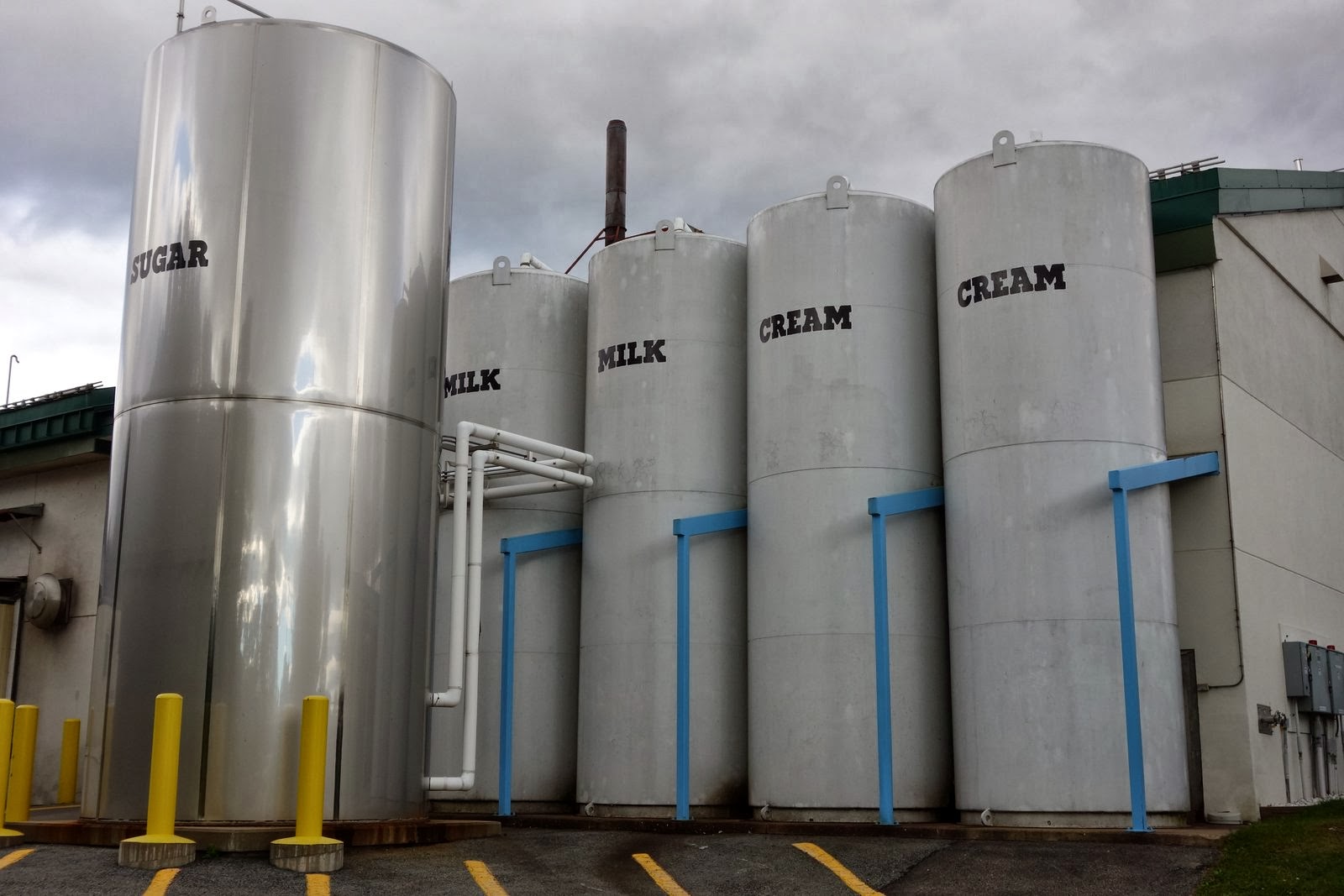
That's a whole lot of milk, cream, and sugar!
One of the funny flavors resting in peace in the Flavor Graveyard!

Friday, October 04, 2013

Fort Stanwix

In Rome, New York, we spent a morning exploring Fort Stanwix.  Completed in 1762, the British built it to guard a significant portage known as The Oneida Carry during the time of the French and Indian War. It was abandoned and fell into disrepair and then was rebuilt and occupied by the colonists in 1776. The fort was held under seige by the British, Loyalists, and Indians for some time. It later burned to the ground and was abandoned. The National Park Service rebuilt it for the nation's bicentennial celebration in 1976. It is really nicely done, and we enjoyed our time there.


This is a picture of a model of Fort Stanwix, a star fort. The corners were built so that sentries on each could have a 180 degree view. There is a fence, a large ditch, and then the fort with its walls a full 14 feet thick! They were built of wood and filled with earth. It's hard to imagine something of this magnitude being built by sheer manpower.
Wives and children of enlisted men had the great privilege of camping outside the fort, but inside the outer fence. They were often employed washing and mending clothes or cooking for officers. Many soldiers couldn't afford to keep a home for their family, so this enabled them to provide shelter and be nearby.
This dim room was a casemate, where about 40 soldiers cooked and slept, ten to a bed! It was believed at the time that stretching out to sleep was unhealthy, so they slept propped or sitting up. We watched a film about life in the fort and there was certainly nothing glamorous about it. It was a hard and uncomfortable life. After the siege, the American forces expected attack, and for fourteen months kept hundreds of men at the ready. Attack never came, but boredom and cold took its toll on the troops, causing several to desert. They were captured and executed.
It was interesting to see how much nicer the living quarters became as one moved up in rank. This was a Junior Officer room, shared by just two or three men.
Families of higher ranking officers were permitted a small space within the fort. 
Can you imagine what it would have been like for women and children living in a fort in time of war? 
  
There was a lot for the kids to do, and they were really able to engage with the history of the place. The boys all got dressed up and the park ranger gave them a lesson on musket loading!
Poppy tried her hand at running a hoop.
They all took part in learning how to clean, load, and fire a cannon. The ranger who gave us a tour had plenty of time to talk answer questions. I'm sad that the national parks are all closed due to the government shutdown and all these people are out of work. 
I can't tell you how long Peregrine paced the bridge, keeping guard. He was in full character, thanking people for visiting Fort Stanwix.

Sunday, September 29, 2013

Erie Canal


We spent a few lovely days visiting a cousin of Erik's mom, Carol, and her husband Dick in northern New York state. We enjoyed their hospitality and the serenity of their lakeside home, and also did some exploring while we were in the area. One day Carol took us to see the historic Erie Canal at Chittenango Landing. We really enjoyed the restored buildings and interactive exhibits while learning about this little slice of American history. I remembered nothing about the Erie Canal from my long ago schooling, so it was fun to see it firsthand and learn together with the kids.

The Erie Canal was completed in 1825 and connected the Hudson River to Lake Erie, opening up a means of trade between the Atlantic states and the Great Lakes. Overland travel was slow and the land was wild, making commerce very difficult. The Canal opened the west of the country to trade and settlement, and contributed significantly to the expansion of the country. Chittenango Landing was built in 1855 as a dry dock where canal boats where built and repaired and could take on fresh supplies for their journey. The canal was only open from May to November, and there were thousands of boats running its length. We have been reading a fascinating book about United States history as we travel, and it's so neat to see all these little glimpses into the past.

The museum has done a great job of restoring and rebuilding. This is some of the machinery in the saw mill and woodshop. 
The kids tried their hand, or foot, at turning a grindstone. There were many hands on exhibits for the kids (and adults) to interact with, bringing history alive for our family.
Timber! Poppy had fun felling a tree and seeing how the endless screw worked to pull stumps and fell trees.
We had fun in the blacksmith shop.
This was one of three dry docks where canal boats could be brought in for repairs. 


A pitching kettle heated a type of resin from evergreen trees . This was applied to the bottom of the canal boats,  which effectively sealed them.
There's nothing like something from another era to spark the imagination.
Inside the store warehouse, a game made of corncobs sat cozily near the pot bellied stove.  It was easy to imagine what a gathering place this would have been.
This was where boatmen, as well as local residents, came to buy everything from lumber and building supplies to dry goods, produce, and milk. Poppy had fun making a pretend cake in the wash basin and chamber pot!
I was intrigued by this dough bucket, which must have been the equivalent to owning a Kitchenaid mixer! Instructions on the lid read: 
Put in all liquids first, then flour. Turn 3 minutes. Raise in pail.
After raising, turn until dough forms ball.
Take off cross piece. Turn out dough with kneader.
Canal boats were pulled by a team of horses or mules that walked alongside the canal on a towpath. Here an elderly gentlemen explained to the kids the protocol for boats passing in opposite directions.
The boats were 96 feet long, with a large central compartment for cargo, a stable on one end, and the family/crew quarters on the other. Each boat would have two sets of mules that would trade off every six hours around the clock. Apparently sometimes children would sleep in the stable too!
This was a canal boat that was constructed in three sections so it could be explored. 

It was common for a family to live on the boat together. The mother cooked, washed, cared for and taught her children in this small room, approximately 13 x 13 feet! You can see the sleeping quarters on the back wall.
Simple rope beds could be raised or lowered. Occasionally the ropes would need to be tightened, and that's where the expression "sleep tight" comes from!
These are the remaining walls of a cannery that stood next to the canal.
Nearby we visited Chittenango Falls, which was beautiful! The leaves were just beginning to turn, and  we enjoyed a little hike down to see the falls from below. 

Saturday, September 28, 2013

Niagara Falls

Niagara Falls
   I have wanted to see Niagara Falls for as long as I can remember. When we were on our way back to the US from Canada, we stopped to see it from the Canadian side. We'd left London in a torrential downpour that morning, and gray skies followed us as we traveled. Shortly before reaching Niagara, the sun broke through, and the afternoon was warm and balmy. Pulling our trailer through the streets, we figured we might have a hard time finding a place to park. The lots near the falls wanted $18 just for a car, and we would certainly have had to pay twice that. Instead, we found free parking a mile away and walked. It was well worth it, and the Falls didn't disappoint! 


We parked about a mile south of the falls, and so we got to walk along and see the rapids.  There is an old rusted barge out in the river, where it came to rest nearly 100 years ago. The story is that it was engaged in a dredging project about a mile upriver when it broke loose from its tug line. With two men aboard, it raced downstream. At this place, the roar of the falls can be heard clearly and the mist from them rises dramatically as the river widens and plunges 170 feet down. Some stories say the two men opened the bottom doors on the barge, causing it to get stuck on the rocks, and other versions say it caught on its own. Either way, I'm sure the men were relieved and anxious as they waited, not knowing whether or not it would hold. Because of its close proximity to the falls, sending out a rescue boat was out of the question. It was 17 hours before the US Coast Guard arrived with a grappling gun, with which they shot a line over to the barge and rescued the men using a breeches buoy. 
This is a corner of the Toronto Power House, constructed in 1906. It was the first Canadian owned power generation project on the Niagara River, which flows from Lake Erie to Lake Ontario. It is a beautiful building, and was intended to compliment the surroundings.
The enormous size and horseshoe shape of the falls makes it difficult to view it all from one place. The Canadian falls are 2,200 feet wide and curved, and the American falls across the canyon are 850 feet wide.  
I almost felt dizzy standing above with such an immense volume of water flowing right beside me.
The sun came out, and we got to see the famous rainbow in the mist. It was truly spectacular! I would love to have had more time to explore and soak in its beauty, but we had to keep moving on. I'm so thankful to have gotten to see it!