Showing posts with label National Parks. Show all posts

Sunday, November 03, 2013

Boston: USS Constitution


Our second day exploring Boston we ventured to the Charlestown  Navy Yard, which is also part of the Freedom Trail run by the National Park Service. The shipyard was established  in 1800, and actively served the Naval fleet until it was closed in 1974. The kids got to complete a second Junior Ranger program, becoming "Master Junior Rangers" of Boston's Freedom Trail! Peregrine wanted to tell you about it, so I'll hand it over to him! 

The gun deck of the U.S.S. Constitution, which
fought in the war of 1812.
(These were all written and directed by Peregrine G, Esq.)
How'd you like to sleep in one of those?
Dad's at the helm!
Oh say can you see, by the dawn's early light...
"Old Ironsides"
This nickname came up during 1812 when cannon
balls seemed to bounce off the ship's sides and an
unknown sailor cried, "Huzzah!
Her sides are made of iron!"
But they are not really made of iron,
just very strong live oak!
Fencing with the U.S. marines!
 Ship's biscuits were no picnic!
Not a doctor  I'd want!
Raphi finally gets to know the meaning of work.
 Hoist the sails!
(I had a lot of fun but it was hard to keep my balance!)
 What is there to tell here?
Zzzzzz...
Firing real muskets!
 We had to plug our ears for this one!


Monday, October 21, 2013

Boston: Freedom Trail

We spent a few days exploring Boston, and enjoyed its wealth of living history. There is so much there that we could have done, but we chose to walk The Freedom Trail. A red brick line connects over a dozen places that have been preserved for their significance during the Colonial and Revolutionary period. This trip has brought US history to life for our family, and we're so blessed to be experiencing these places firsthand.

I always enjoy walking through old graveyard and am fascinated by the inscriptions on tombstones. This was an early Puritan graveyard, and many of the headstones featured a simple engraving of a skull with wings. The skull signified mortality, and the wings the promise of immortality beyond the grave. The inscription reads:
FRANK
Servant to
John Hancock ESQr.
lied interr'd here
who died 23rd Jan
1771

Frank was a slave owned by John Hancock, governor of Massachusetts, whose large monument stands nearby.
PAUL REVERE
BORN
IN BOSTON
JANUARY 1734
DIED
MAY 1818
Costumed interpretors gave tours and presentations along the Freedom Trail. It was so fun to see them dressed up in period clothing. I love the styles from this time period.
This pictures captures Boston for me: old and new settled happily together with a whole lot of life swirling around it all. The Old State House in the center of the picture is Boston's oldest standing building, erected in 1712-13. It served as the seat of the Massachusets legislature, and the Boston Massacre took place in front of it. The Declaration of Independence was first read in Boston from the balcony here on July 18, 1776. There's something sobering about seeing places that were so pivotal in the formation of our nation.  
This was Paul Revere's house in Boston's North End, which now appears to be the "Little Italy" judging by its many Italian restaurants and bakeries. It was from this home that Paul Revere set out on his famous ride to warn Samuel Adams and John Hancock that the British were on their way to arrest them, as well as arousing the militia.
We enjoyed watching a printer hard at work at The Printing Office of Edes and Gil. The printer explained to us the origin of upper and lower case letters. Back when typesetting was a painstakingly long process, where each tiny letter had to be placed by hand, capital letters were kept in the upper case, and "small" letters in the lower case! I love learning interesting little things like that.

We got to watch the printing process, which was very interesting. The printer considered himself very fortunate to have come by this press.
And what was he printing? Copies of the Declaration of Independence, and Peregrine was pleased to buy one for himself and for a friend.
This is the famous Old North Church, where two lanterns were hung to signal that the British were coming by over the water. "One if by land, Two if by sea...." 
After all that walking, we treated ourselves to some delicious Italian pastries: cannolis,  tirimisu, and pignoli cookies. When I was a little girl and we would visit my mom's Italian family, pignoli cookies were a special treat, and it was fun to introduce the kids to their yumminess! We used to joke that you'd better not get between the Great Aunts and the pignolis if you knew what was good for you!
Sometimes referred to as "the Cradle of Liberty", Faneuil Hall is an historic meeting hall and marketplace. It was the site of many meetings where people expressed their growing discontent with England and seeds of Independence were watered and grew. A statue of Samuel Adams stands in front, and on top is a famous grasshopper weather vane. During the Revolution, suspected spies were asked what was on top of Faneuil Hall, and if they didn't know they were treated as British infiltrators! 

Friday, October 04, 2013

Fort Stanwix

In Rome, New York, we spent a morning exploring Fort Stanwix.  Completed in 1762, the British built it to guard a significant portage known as The Oneida Carry during the time of the French and Indian War. It was abandoned and fell into disrepair and then was rebuilt and occupied by the colonists in 1776. The fort was held under seige by the British, Loyalists, and Indians for some time. It later burned to the ground and was abandoned. The National Park Service rebuilt it for the nation's bicentennial celebration in 1976. It is really nicely done, and we enjoyed our time there.


This is a picture of a model of Fort Stanwix, a star fort. The corners were built so that sentries on each could have a 180 degree view. There is a fence, a large ditch, and then the fort with its walls a full 14 feet thick! They were built of wood and filled with earth. It's hard to imagine something of this magnitude being built by sheer manpower.
Wives and children of enlisted men had the great privilege of camping outside the fort, but inside the outer fence. They were often employed washing and mending clothes or cooking for officers. Many soldiers couldn't afford to keep a home for their family, so this enabled them to provide shelter and be nearby.
This dim room was a casemate, where about 40 soldiers cooked and slept, ten to a bed! It was believed at the time that stretching out to sleep was unhealthy, so they slept propped or sitting up. We watched a film about life in the fort and there was certainly nothing glamorous about it. It was a hard and uncomfortable life. After the siege, the American forces expected attack, and for fourteen months kept hundreds of men at the ready. Attack never came, but boredom and cold took its toll on the troops, causing several to desert. They were captured and executed.
It was interesting to see how much nicer the living quarters became as one moved up in rank. This was a Junior Officer room, shared by just two or three men.
Families of higher ranking officers were permitted a small space within the fort. 
Can you imagine what it would have been like for women and children living in a fort in time of war? 
  
There was a lot for the kids to do, and they were really able to engage with the history of the place. The boys all got dressed up and the park ranger gave them a lesson on musket loading!
Poppy tried her hand at running a hoop.
They all took part in learning how to clean, load, and fire a cannon. The ranger who gave us a tour had plenty of time to talk answer questions. I'm sad that the national parks are all closed due to the government shutdown and all these people are out of work. 
I can't tell you how long Peregrine paced the bridge, keeping guard. He was in full character, thanking people for visiting Fort Stanwix.

Saturday, September 21, 2013

Theodore Roosevelt National Park

"The badlands grade all the way from those that are almost rolling in character to those that are so fantastically broken in form and so bizarre in color as to seem hardly to properly belong to this earth."    - Theodore Roosevelt


   As we made our way west from Yellowstone, I expected Montana to flatten out into the gently rolling prairies I remember from my childhood in Alberta, Canada. I have crossed this section of the country by train a few times, many years ago, and somehow I'd forgotten how beautiful it was! Surely by the time we reached North Dakota, I thought, the landscape would be less interesting, right? Wrong! I was surprised and amazed at the stunning scenery, and delighted to come upon Theodore Roosevelt National Park in western North Dakota. We didn't have much extra time, but we took a few hours to drive around the park and do a little exploring. 

    Theodore Roosevelt first arrived in North Dakota's badlands in 1883. He came to hunt buffalo, and by the time he left he'd acquired primary rights in the Maltese Cross Ranch, where he ranched and lived as a cowboy. He actively ranched in the area for several years and maintained interests there for many more. He later said that had it not been for his experience in North Dakota that he wouldn't have become president. It was during this time he formed many of the ideas that later led him to develop a strong conservation program to protect America's natural resources and wild lands. It was neat to get a glimpse of this place that inspired him, and I'm so thankful it has been kept wild and free, the way God created it.


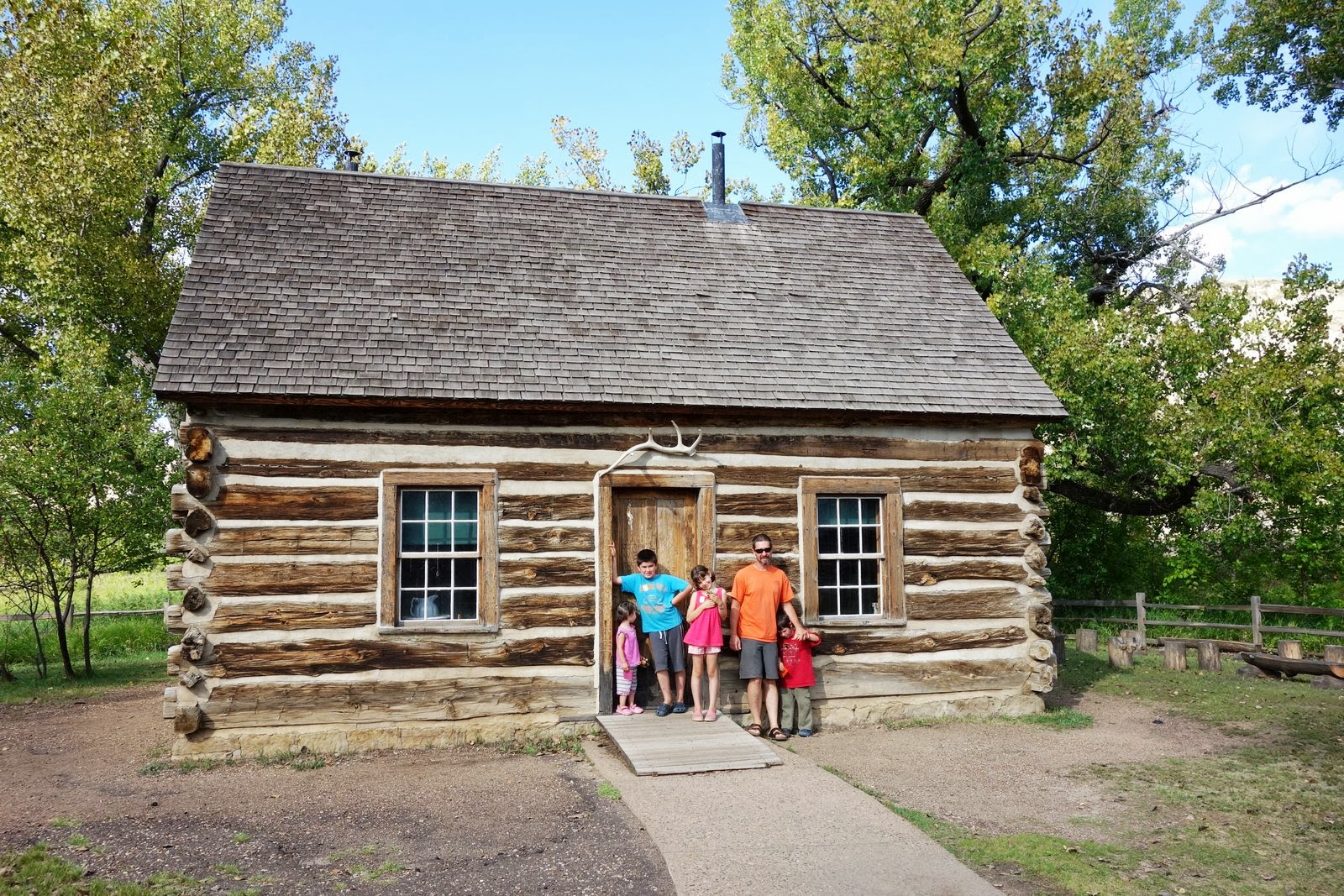
This is the Maltese Cross Cabin that was originally on Theodore Roosevelt's ranch, which was about seven miles from where it now stands in Medora, North Dakota, at one of the entrances to the National Park. With three separate rooms and sleeping quarters upstairs for ranch hands, it was considered somewhat of a "mansion" in its day!


This desk was in another cabin owned by Roosevelt, and he spent many hours recording his experiences in the badlands. It would be interesting to read them someday.
The small bedroom was simply furnished, and the leather trunk with T.R. on it was the actual one he used when he traveled between New York and Medora by train. I suspect that's a buffalo hide on the bed.
We stopped to see a prairie dog town, and the kids were delighted to see the little critters standing guard over their burrows. We had picked up Junior Ranger booklets which had some information and activities about prairie dogs, so of course they were excited to fill out their pages. We also borrowed a family explorer backpack that contained field guides, books, binoculars, magnifying glasses, and other resources to use during our visit. It's well worth checking the National Park websites ahead of time to find out what is available. Many of them also have printable lesson plans and online activities kids can do to learn more about the park and enrich their visits.
Poppy and Raphi peered down a prairie dog hole!
We took a little hike to Wind Canyon, and stopped to watch this big spider catch a cricket and spin it up to save for later. Yum, yum!
Wind Canyon
We hiked along a ridge line trail high over the river valley. We could see a herd of buffalo in the distance.
And speaking of buffalo, we ran into another herd of them down the road! Well, thankfully we didn't actually run into them, but had to stop and wait while they slowly made way for us. This is clearly their park, and we were the guests.
It was wonderful to be so close to them!
  
It was a perfectly gorgeous day, with billowy clouds floating in an endless sky of brilliant blue. The badlands stretched on as far as the eye could see, layers of color stacked and wrinkled and draped over the earth. 
And the kids were sworn in as Junior Rangers of Theodore Roosevelt National Park, under the watchful eye of the  bison on the wall. I'm so glad we stopped to explore and play, and that I was so wrong about North Dakota!