Tuesday, February 21, 2017

Imlil: In Which We Run For the Hills

The view from our guest house, the beautiful, snowy, High Atlas mountain range.

    Apart from getting us in and out of London, a one way ticket from London to Morocco, and lodgings in Marrakech, Imli was the only other accommodation I booked ahead of time. On other trips I've done far more planning in advance, but this time I decided to let the trip unfold a bit more naturally, allowing for more flexibility as we go. This was partly due to not buying our tickets until two weeks before we were leaving. I simply didn't have time to do the research necessary to plan out all the details for a two month trip that will take us to four different countries. I figured that as long as I have an internet connection and a couple of Lonely Planet guidebooks, I can keep a step or two ahead of us, booking accommodations and transportation as we go.

    From the reading I had done, I knew that a few days in Marrakech would be enough and that getting out into nature should be our next step. We engaged a grand taxi to drive us to the mountain village of Imlil, a journey that would take about two hours even though it's less than 45 miles away! From Marrakech's palm lined streets you can see the snowy Atlas mountains in the distance, a beautiful juxtaposition of landscapes. We made our way up a winding mountain road, impressed with our driver's caution, something not to be taken for granted! The village of Imlil is nearly 6,000 feet above sea level, and is the center of mountain tourism in Morocco due to its close proximity to Jebel Toubkal, the highest peak in North Africa. The tarmac ends in Imlil, and many people come from far and wide to trek in the High Atlas and attempt to summit Jebel Toubkal.

Pearl and the luggage got a lift! 

     We arrived in Imlil and were excited to be met by a mule who had been engaged to carry our luggage up the steep, rocky hillside to our guest house.  It was quite a trek up there, and when little Pearl began to lag behind a bit, the mule driver hoisted her up to ride the rest of the way! Before long we were flanked by two other muleteers offering their services for a mere 150 dirhams (fifteen US dollars). I declined repeatedly and firmly, but they accompanied us up the greater part of the hillside. These guys are persistent, not rude like some of the touts in Marrakech, but apparently they hold onto hope long after it's gone!  

   We arrived at the doorstep of the Riad Atlas Prestige a bit out of breath and were welcomed by Ibrahim and ushered out onto the patio where we sat in awe of the gorgeous, snowy Atlas mountains towering above us. The air was crisp and cool, but we were warmed by the sun and our exertion, and delighted to sit and rest in such a place. Over the railing was a sheer drop, and we could look out across the valley, over Imlil, and to other small villages spread out across the hillsides, the minarets over several mosques residing over each community. Ibrahim appeared a few minutes later with steaming mint tea, poured high into small glasses for each of us, and a plate heaped with nuts, raisins, and dates. Once we had rested a while we were shown to our room where we settled ourselves for the evening.

Our room came complete with slippers and jellabas, the long, hooded cloaks worn by Moroccans. Poppy and I had fun  trying them on!

    Ibrahim asked if we wanted dinner, and as we weren't keen to walk down into the village again that day, we gladly accepted that offer. We usually prefer to eat in the little, local places, which tend to be cheaper and often better quality, but we thought for our first night it would be good to stay "in". Dinner in Morocco is usually offered between about 7 and 10 PM, so we've had to adjust to eating later than we usually do, which means the children often get to bed later as well. (Now if they would just figure out that sleeping in is acceptable!) We walked downstairs from our room, breathing in the cool mountain air, gazing in wonder as a nearly full moon rose over the Atlas, its light illuminating snow-flanked granite peaks. I love the mountains, which I attribute to being born in Canada's Rockies.
The cozy room where we ate breakfast and dinner.
    We were ushered into a curtained room lined with low couches. A wood fire crackled in the stove, spreading cozy warmth, and candlelight flickered on tables. We sat down wearily, hungrily, and helped ourselves to bread and olives, the only proper way to begin a meal in Morocco. Soon a steaming bowl of soup was placed before each of us, and we sipped its delicate broth from small, carved wooden ladles. It was delicious, and I would have been satisfied with the meal at that point, but, as it turned out, we were just getting started!

Soup of the evening... beautiful soup.

    Our soup bowls were whisked away, and in front of us was placed a still sizzling tagine. Steam billowed as the lid was lifted, releasing the tantalizing fragrance of chicken slow cooked with preserved lemons and olives, topped with a variety of vegetables. It was delicious, with surprising layers of flavors, both sweet and savory. At this point we were really, truly full and more than satisfied, but then came tea! More small glasses of sweet mint tea were sipped, followed by a platter of oranges and bananas. I had expected mediocre guest house food and instead enjoyed the most excellent meal of our trip so far. We wrangled our very tired kids upstairs for bed, with full bellies and happy hearts. A few minutes later there was a knock on the door, and one of the guest house guys was standing there with four hot water bottles for the kids!


Tangines simmer on clay braziers in front of many little shops and restaurants. For around 30  or 40 dirhams (3 or 4 dollars), you can choose the one you want, usually goat, beef, lamb, or chicken with several kinds of vegetables, served up with a basket of crusty bread.


     The next day we enjoyed breakfast in our guest house, a typical Moroccan carb-fest of bread, crepes with jam, and thankfully, hard boiled eggs and yogurt. (Sometimes it's just bread; one place served us no less than six varieties of bread at breakfast one day!) After satisfying our hearty mountain appetite, we relaxed on the patio for a while in the sun, writing postcards and working on our journals. A Moroccan family was staying at the guest house at the same time, and she and Pearl engaged in a game of Monopoly, made quite humorous by the communication and cultural gaps. (Out of money? No problem, the bank has plenty! Just take some.) I enjoyed my visits with them over the next few days, and Pearl and the little girl played together several times. After an enjoyable morning we decided to walk down into the village for lunch. 

Tiny tagines for sale in a little shop in Imlil. Pearl decided I must have one of these, and bought a turquoise one in my favorite color with her own money. She snuck it home and wrapped it up in a scarf to give me as a gift. Sweet girl. 

    We enjoyed rambling around the small village of Imlil. It reminded me so much of time spent in Nepal in 2000 and 2001, with its beautiful mountain setting and an abundance of shops organizing treks and selling used trekking gear. I never knew the Atlas were a prime trekking destination! You can do anything from a small hike nearby to a couple weeks. Given the beautiful setting, I can see why people come here to spend time in these mountains. 

These two muleteers offered us their services repeatedly as we walked around the village. When it came time to walk back up, we bartered a bit and got to ride the mules for 20 dirhams, the equivalent of two US dollars each. The kids were absolutely thrilled! (And I was glad we'd not been roped into the fifteen dollars ride the man had offered us the previous day. We must have had that "just arrived" look! I asked Ibrahim later how much a ride should be and he said 30-50 dirhams, so I guess our bartering skills are up to muster.)


I wasn't going to buy a carpet, but...

    Really, truly, I had no intention of buying a carpet! Nope, not me. We traveled with only carryon luggage, although I did plan on bringing one extra bag home with us, knowing there would be a little shopping along the way. About a third of the way up the hill was a cooperative that sold carpets and other handmade items. On our way down, the salesman invited us to come take a look, and we told him maybe later. When we walked by in the late afternoon, of course he was there waiting for us. We walked in and Mohammed began showing us some rugs while the children looked at the magic boxes, little carved cedar puzzle boxes that fascinated them. 

    Mohammed is the father of seven children and lives in a nearby village, walking 30-40 minutes to work each day. He lives with his parents and a couple of his siblings and their children, a total of around 20 people in the household. Only a few of them have paying jobs, which seems to be a fairly typical situation in Morocco, and those that do financially care for the rest, who contribute to the household in other ways. I have long loved textiles, and so of course I was thrilled to look at the carpets, and Mohammed was happy to answer my many questions. They are made in the traditional way, from wool that is sheared and spun and dyed with natural pigments, the way it's been done for centuries. Often a women has a loom in her home and works on it in her found moments in between caring for children and her many other responsibilities. I delighted in seeing the colors and beautiful patterns, all the while saying I couldn't take one home with me. Erik pulled me aside and told me that if I wanted one, I could buy it. Plot twist! Being the submissive and agreeable wife I am, I settled on a medium sized rug, assured it was of the finest quality, bartered appropriately, and became the happy owner of a Moroccan carpet.  And like Mohammed said, I made him happy, and he made me happy, and now he could go and buy tea and sugar and couscous and meat and vegetables for his family! (The carpet pictured above isn't the one I ended up with. Mine is smaller and has a different design. This one was a bit out of my league!)

I'm afraid the kids are ruined for normal hiking now. Can't we just get a mule to carry us when we're tired? 

    We engaged a local guide through our guest house, and the following day he, along with a mule and muleteer, led us on a trek around the valley. It was a beautiful, clear day, and we hiked over seven miles up a steep hillside, through patches of icy snow, and across a rocky valley just beneath the snow line. We walked through an ancient Berber village, its steep stone paths worn by countless feet over the centuries. We continued along, making a wide circuit, stopping to rest among pine trees, where we ate oranges and bread left over from breakfast. The three younger kids took turns riding on the mule, and I even rode for a short time. (I like going up, but going down? Not so much.)  We came upon a little herd of baby goats that scattered, bleating, as the kids approached. In a few places we saw mules grazing contentedly, probably glad to be given a respite from the carryon of burdens. 

A glimpse of our trekking party. I was so proud of how well the kids did during our long day. 

The hillsides around Imlil. 

    Out of seemingly barren land, these hard working Berber people have fashioned terraces for growing their crops of wheat and vegetables, along with fruit trees. Apples, cherries, apricots, walnuts, and plums, their buds swelling, dotted the hillsides. In a few more weeks they will burst forth in delicate pink and white and red blossoms. I was continually amazed to see the ingenious water irrigation systems in place, diverting water from the streams and rivers. We walked alongside a concrete channel complete with several sluice gates for watering the terraces. It also powered a small mill, presumably for grinding wheat into flour.

One of the Berber villages we walked through. Though a road has been built, it doesn't appear that too much has changed here for centuries. 

Our guide, Hassain, preparing tea.

    Hassain either didn't have much sense of time, or was unused to leading parties that contain small children. We finally stopped for lunch in the mid-afternoon, hungry and tired and very ready to take a break! We were led through the dark and narrow stone passageways of a Berber home and out onto an open rooftop where a table was laid out for us. Glad to have a chance to rest, we sat down and watched as Hassain prepared the tea. As the gunpowder green tea and fresh mint leaves  brewed, he asked if we'd like sugar, and we said sure. He proceeded to grab two lumps at least the size of golf balls and throw them in the pot! Needless to say, certain children thought it was the best tea ever! 

Little boy, big tagine.

   We were grateful for the large loaves of bread and "salad" that arrived shortly after the tea. The salad consisted of chopped tomato and pepper, fresh herbs, and cumin, similar to a chunky salsa, only not spicy. It was a delicious start to our meal, and was soon followed by not one, but two steaming tangines of savory meat and vegetables. We ate as much as we could and it felt like we hardly put a dent into the food! After that was a bowl of delicious tangerines. I love that dessert in Morocco is typically fruit of some sort. There are definitely sweets to be had, and plenty of sugar, especially in the tea, but for the most part fruit is considered an adequate dessert. One of my favorites was a platter of sliced oranges sprinkled with cinnamon.

    After our trek, we had one more day to enjoy Imlil. We spent it resting up after our big outing, something we find necessary for travel with children. It doesn't pay off to push everyone too hard, and so we try to balance the big days with more restful ones. We walked into the village again, spent time visiting the Moroccan family staying at the guest house, and worked out plans for our onward journey. I loved our time in Imlil, and am so glad we were able to be there. 


Tuesday, February 14, 2017

Shopping in Marrakech: In Which We Buy Some Things, Including an Education


The narrow, winding streets and alleyways of the walled medina of Marrakech provide an endless array of wonders and curiosities. Compared to many, this street is broad and straight and not at all crowded! There are many little alleys and paths that branch off and then twist and curve around. It's easy to get lost and disoriented, especially as there are often high walls on either side. It's fun to ramble around, not quite sure what you might stumble upon. We enjoyed several outings, looking at the interesting things available in the shops. We didn't buy much, as I'd heard that outside of Marrakech we would find better prices, but it was fun to look around.

Some of what we payed for was an education, and we learned quickly that it's always best to be clear about what you want and what the cost is up front. There was a little street where several vendors sold chunks of roast lamb. After tasting a sample, we were ushered up a couple flights of stairs and seated at a table. We assumed the man would return momentarily to ask us what we wanted, but instead he came bearing an enormous slab of steaming meat, a basket with several small, round loaves of bread, and a little dish of salt mixed with ground cumin to sprinkle on the lamb. Did I mention it was a large amount of meat? And that my children, with the exception of Peregrine, will not eat lamb? And that utensils were not part of the equation? The kids happily munched on bread while Erik and I dug into the hot, greasy meat with our fingers. We hardly made a dent in it, and kept wishing we would/could have communicated before he brought us enough meat for ten people! It was a costly lunch, around $35, probably more than we've spent on any other meal for the whole family here in Morocco. Ah, well... we learned something.

Olives? Yeah, they sell those here. All kinds of olives, olive oil, and other things preserved in jars. Also, lemons preserved in salt are a major ingredient in Moroccan cooking, and you will see tubs and jars of those for sale as well.

Slippers, slippers, everywhere, in every conceivable color. Some even have curled toes!

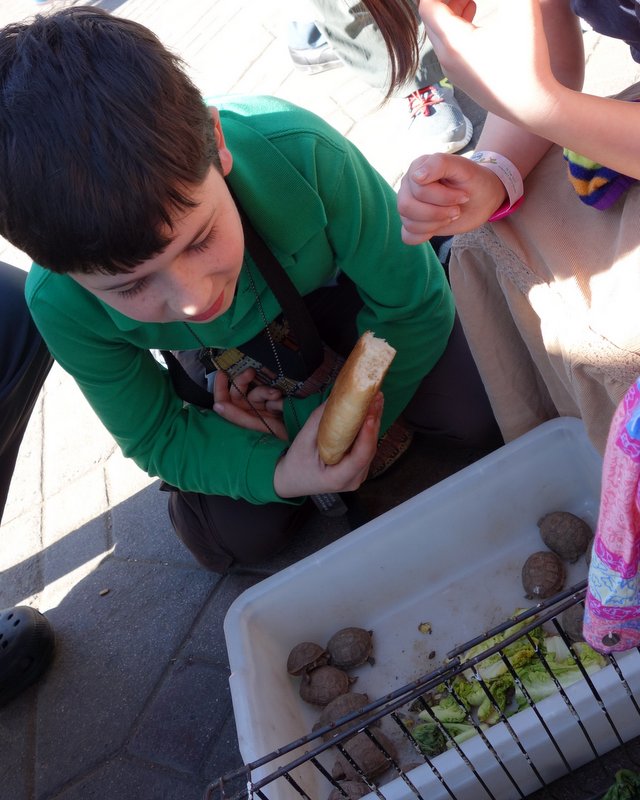
There were several places selling tiny baby turtles, and of course the kids were thrilled. The vendor at this one was trying hard to convince me to buy a turtle, telling me how he would provide a small box and food and that it would be "no problem" for me to take the turtle home the airplane. I told him it would be a problem when I tried to take the turtle back into my country. Without skipping a beat, he told me it would be "no problem" because this turtle was Jewish, not Muslim.  This, of course, is referring to President Trump's recent ban on immigration from several Muslim nations. Trump has come up in conversation with several different Moroccans we've spoken to, and it's been quite interesting to hear their perspectives. In general, I'd say they are much more able to see the bigger picture and not be reactionary. One man told us he thinks Trump is "strong, not crazy", but later said, "maybe a little crazy." What seems entirely lacking in their attitude is being offended. I was honestly a little concerned about coming to a Muslim country right now in light of everything that has happened recently, but the people have been nothing but friendly and hospitable, and are happy to talk with us without assuming our president represents our way of thinking.

The Souk des Tienturiers, or Dyers Markert gave me a little thrill, as it is where skeins of wool and pieces of cloth are dyed. I have forayed into some natural dying and am fascinated by the history and process of it.  "I am the souk of a thousand and one colors, but they come at a cost: the hard labor of the Sebbhagine dyers. I provide the weaving workshops with the yarn they need to produce all of the carpets you see in the medina. While there were once many dyeing workshops, now only a dozen remain. Prepared skeins of white yarn are brought here by their owners to the dyers, who weigh them in large scales. Inside, where small rooms serve as dyeing workshops, the dyers place the yarn in pots of boiling water. The yarn is then dyed using natural materials: wild almond for green, pomegranate peel or saffron threads for yellow, indigo for blue, and poppy for red. The skeins of yarn are then hung in other semidetached rooms in the dyeing workshops. After they are drained, they are taken out and hung on the old walls and trellises in the area, giving it its colorful design. The colors obtained are not always the same, with different shades being produced through the drying process. Stalls and workshops sell various handicrafts in the adjacent streets." (Text of a sign in the souk.) 

In one little courtyard in the dyers market we spotted a few felted goods, including some slippers. Erik and I both have wonderful, felted slippers at home and have never found any others that keep our feet as warm. We'd considered bringing them, having heard that Moroccan homes rarely have heating, but decided not to due to space constraints. After one night in our riad, we regretted not bringing them! We'd seen these slippers the first day and not bought them, so the second day we went out looking for them. We found the first place we'd seen them, and then found one other place nearby that had some we liked better. Still, we thought we'd look around a little more, so we continued on. We walked further into the souk and ended up in a little shop called Mr. Boho, full of handmade shoes and slippers. When we asked the shopkeeper if he had any felted ones, he said he could get some and ran off. We jokingly said to each other that it would sure be funny if he came back with the ones we'd just tried on at another shop. Sure enough, Mr. Boho returned a few minutes later with the very same pairs we'd tried on, and just happened to have a handful of felt necklaces I'd admired at the other place as well! These guys all seem to know one another and work together. We enjoyed a long conversation with Mr. Boho and left with two pairs of felted slippers and one necklace. Our feet have been happily warm ever since.


The metal lamps! Let's just say it's a good thing I'm limited in the amount of space  I have to bring things back.

Baby chameleons? But of course! And do my children want to buy one? But of course!

This beautiful, colorful square we came upon one afternoon was the first place we'd seen women selling their wares. It is called Rabha Kadina  and was once the site of the slave market, and later a grain market. Now it is lined with little apothecary shops selling spices, herbs, remedies, cosmetic items, oils, and potions. Apparently this is where the local healers and magicians come to stock up on ingredients, and I read that the little animals like turtle and chameleons sold in the apothecaries may be used as ingredients in traditional medicine, or used as sacrifices. I guess that would explain why they're sold in the apothecary shops.

Erik bought some menthol crystals to help clear up stuffy noses. Powerful stuff.

The textiles get me every time. Again, it's a good thing I have some constraints!

Black and white, or color? Both, please.

Snails, a local delicacy, seem quite the popular snack. No one in my family has wanted to try them yet.

All manner of interesting things could be found in the apothecary's shop- chunks of indigo, powdered dyes of various colors, licorice sticks, cinnamon bark, frankincense, rosebuds, argan oil, little clay pots of poppy powder that, when moistened, stain the lips red, chunks of kohl to line the eyes, terra cotta scrubbers to smooth the feet, "Moroccan toothpicks", and more.


Out and About in Marrakech

The flag of Morocco, bigger than life! 

“I believe that Marrakech ought to be earned as a destination. The journey is the preparation for the experience. Reaching it too fast derides it, makes it a little less easy to understand.”


― Tahir ShahIn Arabian Nights: A Caravan of Moroccan Dreams


I had originally wanted to save Marrakech for a little later in our trip, easing into Morocco a bit more gently. I looked for a place to stay further out of the city, but couldn't find anything that met the criteria I had. (Reasonably priced, room to spread out, access to inexpensive food, relaxing environment.) There were plenty of more expensive, "resort" options, but I didn't want to be stuck eating costly restaurant food. In the end, I'm the time we had in Marrakech was perfect, due largely to our stay at Dar Kalam, which was only a short walk from the action, yet quiet and secluded feeling. We were able to rest and relax, but also step out the door and explore. It was a good introduction to Morocco, and I'm glad we started there.

These men in colorful costumes hope you will notice them and buy some water to drink from the brass bowls they carry. All this and more you will find in Djeema el Fna, the main square in the Marrakesh medina. Apparently the show here has been going on for centuries, and while there are plenty of tourists joining the fray, it's largely Moroccans out and about. There are musical acts, acrobats, storytellers, snake charmers, sellers of all sorts of untold wonders, as well as food and drink. I found the square to be a bit on the overwhelming side. The first evening we were in Marrakech, we found our way to the square after hearing it was a good place to find supper. The food booths were arranged in two rows that faced one another, so we had to make our way down the "gauntlet" of hungry crowds mixed with aggressive hawkers each trying to convince us to choose their place to eat. Erik and I each held tightly to the hands of the little ones, while Peregrine and Poppy stuck close to us. Pressed on every side by the throng, we made our way down the line, first politely refusing the offers, and then matching their aggression with the force required to shake them off, sometimes literally. We emerged triumphant and still hungry, and ate at a little place around the corner where we gave our business freely and under no compulsion. I'm not big on crowds at the best of times, but in a new city, at night, and with my children, this is an experience I'd rather not repeat. We kept subsequent visits to the square limited to daytime hours and avoided the food area and the snake charmers. 


Of course there are taxi stands, where you can choose from a petit taxi or a grande, or you can wait for a bus to take you to your destination, but why would you when you can take a horse drawn carriage? Not just for tourists, this seems to be an enjoyable way for Moroccans to get around as well. My animal loving kids were thrilled to take a ride around the city.


Is it okay to text and drive if you're driving a team of horses? I hope so.

The snake charmers were anything but. They would cheerfully offer to let the children hold their snakes and then encourage mom and dad to take a picture. Of course we would expect to bestow on them a little money for this privilege, knowing it's their livelihood, but when they started hissing (figuratively) and demanding the equivalent of twenty dollars, we felt pretty taken for a ride! Especially when one man, as Peregrine protested, draped a snake around his neck and then grew angry with Erik for refusing him money. From this time we kept a wide distance between ourselves and the snake-y snake charmers, knowing not even to catch their eyes as we walked by. 
My stolen picture.... somehow I snapped this while Erik was wrangling over money with the other snake charmers. I'm sure fangs would have been bared had they noticed me.


We spent a pleasant afternoon strolling around the Bahia Palace, former home of a Grand Vizier. It appeared that no expense was spared, and he had all the finest craftsmen at his disposal for over a decade. The results are still jaw dropping. Everywhere one looks, gorgeous and intricate tiles, carved and painted ceilings, grand archways and pillars, courtyards, and gardens fill the spaces of the palace grounds.
None of these photos even begin to do the palace justice! Don't forget to look up, as  even the ceilings are designed to  delight and awe you.


This beautiful fireplace was surrounded not only by tile work, but with intricately carved built in shelves. Sigh. And those kids? I like them a lot.


Beauty, beauty, everywhere!


This building was the harem. It was hard for me to imagine how the palace must have looked when it was still inhabited. The buildings are mostly large rooms, some with one or more alcove rooms. There were no furnishings or draperies to hint at how it was set up. Apparently the Vizier had four wives and twenty concubines in his harem.


A magical garden to explore, like a fairy story!


An alcove room off of one of the large open rooms.


Beautiful tile work everywhere, this fountain was in the large garden.


A rare photo of the man behind the magic!


The cats of Marrakech. We were pleasantly surprised by how clean the city was, and there was a noticeable absence of the roaming street dogs so often found in many cities. The cats more than made up for it, and my kids had a very hard time not petting them! 

Tuesday, February 07, 2017

In Which we Stumble Into Ali Baba's Cave


We stepped outside our door in Marrakech yesterday morning, and after a nod to the mule on the left, looked straight ahead, down a narrow passage with high walls on either side. There a pair of men were working to paint or repair a set of massive, wooden doors. Curious, we thought we'd go over and look. The men smiled and beckoned us to come closer, then ushered us over to an unimposing open door at the end of the passageway. 
We could see more doors leaning against the walls inside, and I assumed they wanted to show us their workspace. We stepped inside.

Instead of a workshop, we came out into a huge, open room that immediately brought to mind Ali Baba's cave, filled with treasure. Part art gallery, part museum, hundreds of years of Moroccan artifacts and history are housed in this 16th century palatial riad. We were greeted warmly by Saeed, an American educated gentleman who had spent years working as a commodities trader in London. He is now helping to curate this amazing collection of antiques and art. 
Raphael was particularly fascinated with this compass. Saeed was happy to let him see it and show him how it works.

He happily spent the next hour leading us from room to room, down passages that opened onto more rooms containing untold treasures in this riad turned gallery. He let us take pictures, which is not a given, and enthusiastically answered our many questions as we wandered, in awe of all we were seeing. It was like a private tour of an exclusive museum.
This doesn't look like much, but the pieces leaning up against the wall  are one of the elaborate carved and painted ceilings that is hundreds of years old. Saeed told us they been offered half a million dollars for this piece, but aren't interested in selling. They have plans to turn this riad into more of an official gallery and museum and have spent the last year building a restaurant. This ceiling will go into the restaurant. 

He told us many collectors from around the world come to shop. Not all of the collection is for sale, and he said he has to feel the piece is going to a good home or he won't sell. Apparently some collectors will buy up items similar to those they already own and destroy them to maintain the value on their rare pieces! Who knew? Saeed told us that if he doesn't like the feel he gets from someone, he will put them off when they ask about a price.

I was particularly fascinated with the large collection of items from the Moroccan Jewish community that thrived here for centuries. Prior to the 1950s, it's estimated that there were around 300,000 Jews living here. Many of them settled here after fleeing the Spanish Inquisition, and they lived peacefully alongside the Muslim majority. In Marrakech there is a Jewish Quarter where the architecture is different. From what I understand, there are few if any Jews left in this city, but there are communities remaining in Fez and Rabat. This was a beautiful, silver menorah. 


Saeed carefully opened this Torah scroll for us to look at. It's over 200 years old, and made of gazelle skin. I keep wondering how these treasures became lost to the Jewish community and ended up here! I imagine a lot was left behind when people left he country, but some of these are such special items! 


I don't know how old these are, but this is a set of Jewish wedding clothes! 

A beautifully embroidered Torah cover.
This was in a glass case and not the best picture, but it is a large leather satchel that was a Rabbi's bag. The stitches are silver!

This is another example of the amazing Jewish handwork. I believe Saeed said this was the belt that would be worn over a kaftan. He said the Jews are the finest craftsmen in the world! The stitches were beautiful and intricate.

Finally, so that you can look stylish and be comfortable while riding your camel, we have an ornate camel saddle for you! 

And stirrups. Don't forget the stirrups.


None of these pictures do justice to any of it, but I hope you can get a hint of the grandeur of it all!  Over the doorway and hanging down on either side was a heavy, embroidered tapestry. 


Here is a close-up of the embroidery! Can you imagine? 

Oh yeah, the Romans were here at some point as well. The Pax Roman and all that. There are some Roman ruins somewhere around here.
I could have stayed and asked questions and soaked in all of it for days. I couldn't figure out what these were, so of course I asked. The little pot is for ink, and the long part would hold the writing instrument. Saeed explained that the scribe would bring his tools of the trade along when writing up binding documents. Of course.

I am still in awe, marveling at the wonders we stumbled upon. We thoroughly enjoyed our visit with Saeed. He was entirely welcoming to our whole family. I love the attitude toward children in this country! I can only imagine my stress in a similar situation in other places, but it was "no problem" to let the children look and even touch. I'm so thankful for these unexpected and wonderful blessings!